April 23, 2013 by Emily Bernard
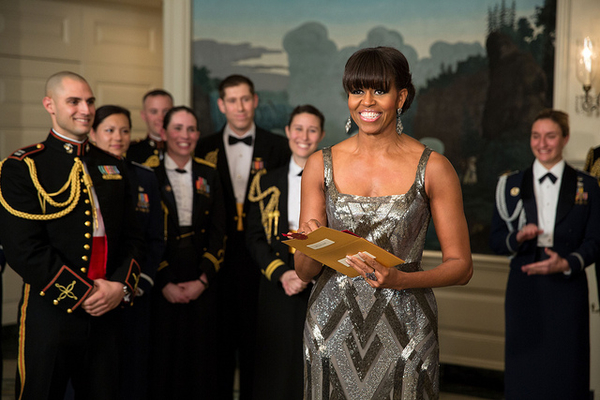
Earlier this year, Oscar viewers were shocked when Michelle Obama appeared via satellite to announce the winner in the Best Picture category. In a post-Oscars interview, Ben Affleck, director of Best Picture winner Argo, confessed that he had wondered if Mrs. Obama’s appearance was a hallucination. Maybe part of Affleck’s confusion had to do with the fact that there were so few visible brown bodies at the Oscars this year, in general.
Michelle Obama’s ubiquity is not imaginary. It is really she: at the Oscars, dancing and racing with Jimmy Fallon, on the cover of April’s Vogue, and, very recently, gushing over Harrison Ford during a visit he paid to the White House. On the heels of these appearances, commentators on both ends of the political spectrum have wondered at the wisdom of so much exposure. At the same time, the public appetite for Mrs. Obama has gone unabated since 2008. Some say it has actually increased; Forbes lists her as No. 7 on its roll of the world’s most influential women.
Americans admire and adore Michelle Obama; we delight in her seeming authenticity and accessibility. The creators of the blog “Mrs. O” mull over the fashion choices of the first lady as if they were neighbors peering over a fence. Like so many other people, I myself enjoy imagining that I somehow know the “real” Michelle Obama, particularly after I published, with Deborah Willis, Michelle Obama: The First Lady in Photographs in 2009. The more photographs of Mrs. Obama that we examined, the more available to her public she appeared to be. Today, it seems as if Mrs. Obama is everywhere, even our living rooms.
Michelle Obama faces criticism that she is overexposed in a world where everyone is overexposed. Our public (and some we thought were private) deeds and misdeeds are available for view at any time; the line between past and present seems no longer to exist. Mrs. Obama’s college thesis, for example, nearly 30 years old, is available online. A simple Internet search pulls up childhood photos of Mrs. Obama and wedding photographs of the first couple, the kind of artifacts that used to be reserved for the enjoyment of family and friends. As Mrs. Obama has herself said, “Everybody’s kitchen-table conversation is now accessible to everybody else.” Perhaps it’s not the quantity of coverage that some people find objectionable, it’s the quality.
“She ought to be under consideration for a seat on the Supreme Court, not recruited as a presenter in some Hollywood movie contest,” sniffed Washington Post columnist Courtland Milloy in his February 26 column. Mrs. Obama is not the first White House official to have a presence at the Oscars. Ronald Reagan and Laura Bush appeared in taped segments for the 1981 and 2002 Academy Awards shows, respectively. President Roosevelt spoke at the Oscars via radio in 1941. But none of these occurrences elicited the negative backlash that has been generated in the wake of Mrs. Obama’s Oscars appearance, and we as a culture should ask ourselves why. It is undeniable that a spotlight of unprecedented intensity shines on our current first lady, and many wondered just what she was doing there. “Having fun,” concluded Washington Post national staff writer Krissah Thompson. I disagree. She was at work.
Michelle Obama used the Oscars to promote her “Joining Forces” initiative, just as Nancy Reagan appeared on Diff’rent Strokes, a sitcom that ran from 1978 to 1985, to plug her “Just Say No” anti-drug campaign. Commentators on the right sneered and accused Mrs. Obama of using the military as “props,” but there is no American institution more defined by public display than the military, with its parades, uniforms, and tightly choreographed appearances. Similarly, Mrs. Obama, like the actors she was addressing that night, is on stage all the time. This continuous scrutiny is a consequence of being not only first lady but also the first African American first lady. What she has done quite artfully is finesse the inevitable attention in order to mount two very successful campaigns.
Dancing with Jimmy Fallon, Ellen DeGeneres, and a host of other television personalities is also work, an opportunity to stump for her “Let’s Move!” campaign, not with speeches but with her body. For someone who thrived in the buttoned-up world of corporate America before she assumed her position in the White House, the constant attention paid to her body—even when friendly—must be jarring, to say the least. Mrs. Obama’s “Let’s Move!” campaign has given her the opportunity to channel that attention into a very serious cause.
Her work has been effective. The Healthy, Hunger-Free Kids Act, which increased funding for school breakfasts and lunches above the inflation rate for the first time in 30 years, is a direct result of her persistence. Mrs. Obama uses the attention to her body to create a counter-narrative: against the onslaught of media representations of the black female body as a spectacle of hyper-s*xuality, Mrs. Obama’s body evinces control, industry, and wholesome play. It’s all captured in the images of her playing Double Dutch, a jump rope game that requires precision and endurance of its participants. Even Mrs. Obama’s favorite game demands work. We rarely see her in repose, unlike most of her less-athletic first lady predecessors.
When asked by Courtland Milloy what kind of projects she would like to see the first lady involved in, E. Faye Williams, chairwoman of the National Congress of Black Women, said, “I’d like to see her promote the important work being done by women in this country.” But that’s exactly what Michelle Obama is doing, and this goes unacknowledged because we, in this country, routinely discredit the work that most women do, which is to tend to home and family. From her earliest days on the public scene, the first lady has reminded us that she is, primarily, a wife and a mother. At the 2012 Democratic Convention, she dubbed herself “Mom in Chief.”
Probably the Michelle Obama of 10 years ago would have fit in “lawyer” among those descriptors. But first ladies who attempt to maintain distinct professional identities pay a price. Witness Hillary Rodham, before she got wise and became Hillary Rodham Clinton.
What Mrs. Obama has put on display, and perhaps “overexposed,” is her commitment to women’s work. The Michelle Obama who stood shoulder to shoulder with the most powerful people in Chicago will always be with us. Thanks to the Internet, she is only a couple of clicks away. The first lady who campaigns for families and children has managed to marry her powerful skills as an advocate with the demands of her latest roles of first mom and first wife.
More:
http://womensvoicesforchange.org/69953.htm...
 Posted By: How May I Help You NC
Tuesday, April 23rd 2013 at 10:23AM
You can also
click
here to view all posts by this author...