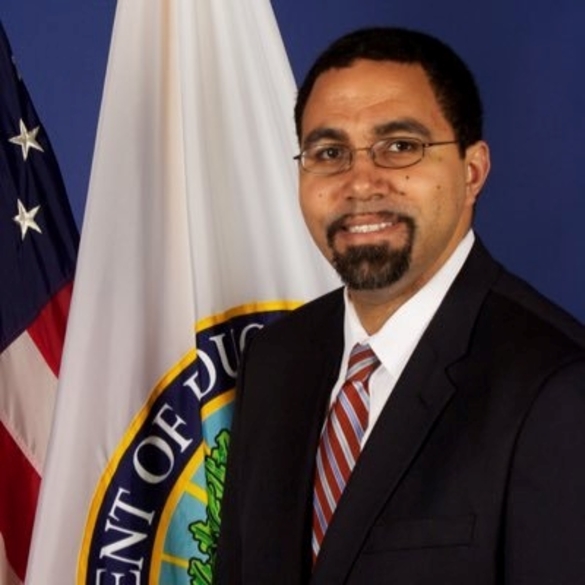
Good evening everybody. Let me first thank Laura and Nathan for their leadership and for their extraordinary vision and the role PTA should play in our national education conversation,
We gather in a city that has experienced extraordinary trauma in recent weeks. Before coming here tonight, I spent time at First United Methodist Church of Orlando with a group of LGBT young people and allies from the area talking about the impact of the events at the Pulse nightclub on them and their communities. We also talked about their experience in school. I have to say I was reminded in that conversation that the events at Pulse were a national reminder of the impact of hate in our communities. As the young people talked about their experiences of bullying and harassment in school, as they talked about their difficulties just to be themselves in school, I was deeply struck by the urgency of the work we need to do together to ensure that schools are safe and supportive environments for all kids.
I know this has already been very much a part of your conversation here at the conference; I want to thank folks in this room for your leadership, for saying our schools have to be safe and supportive places for every child. When the President was here talking about the events at Pulse he made the point that there is no "us and them," it's just us, the United States of America. And it is in that spirit we must move forward and take this event as a reminder of the urgency of our work as American citizens to knit our communities together, to embrace our communities and all of their diversity. Diversity of race, diversity of socioeconomic status, diversity of religions, diversity of languages in family structure, diversity in s*xual orientation, and diversity of gender identity, we must embrace all of our diversity and embrace all of the diversity of our young people.
I appreciate that the PTA is very much a partner in that work and a leader in that work. I also appreciate the leadership of the PTA around the Every Student Succeeds Act, or ESSA, and ensuring that communities have a good understanding of what the law provides, especially of what it provides to broaden the definition of educational excellence and to develop better and smarter interventions in schools that are struggling.
I'm also grateful to the PTA for the difference you make in the lives of families every day. My wife and I are PTA members in the Montgomery County schools, and we love our schools and we love our PTA. We see the difference that it makes in our schools to have strong, engaged parent leaders who are not only part of the day-to-day life of the schools, but the decision making in our kids' schools.
I also appreciate the partnership of the PTA around the work to rethink and improve the role of assessment in schools. PTA has been a national leader in demanding that we continue to have good information for parents and teachers every year about student performance and at the same time, the right size of the role that assessments play in schools. You've been leaders in ensuring that we're thoughtful about how we focus kids' time and teachers' time on instruction and learning, and ensuring that we are having assessments that are smarter, better, and—indeed—fewer. And that we are thoughtful about where we have redundant assessments that we can eliminate or assessments that are of low quality that we can improve. So I appreciate the leadership around all of that, and I know that we want to continue to be partners in that. And I believe that ESSA creates opportunities for us to continue to work together to help states and districts to be thoughtful about this work. We've put out guidance's describing how states and districts can use federal resources to review the assessments that are given and decide which ones are important to continue and which ones can be eliminated, and which can be improved, and we want to continue that work together.
We're also committed to seizing the opportunity within ESSA to ensure a well-rounded education for our students. Music and art and world languages, physics, chemistry and biology, social studies, civics, geography and government, physical education and health, coding and computer science—these aren't luxuries that are just nice to have; they are what it means to be ready for today's world.
Today, I'm going to talk about one more essential element of the well-rounded education we want for all children, and that is diversity. Like math and reading, like science, social studies, and the arts, diversity is no longer a luxury; it's essential for helping our students get ready for the world they will encounter after high school and, increasingly, throughout their lives.
A couple of years ago, my predecessor, Arne Duncan, stood at this podium, your podium, and announced a turning point: it was the year that students of color became the majority in America's public schools. Crossing that threshold poses some profound questions about what kind of country we intend to be. Our public school system stands on a philosophical foundation advanced by Horace Mann in 1848: that all our children — regardless of their wealth or station—should go to school together at what he called a common school. The common school would serve, in his words, as "the great equalizer."
He saw the common school as a radically American response to, and I quote, "the European theory, [where] men are divided into classes—some to toil and earn, others to seize and enjoy." Mann's idea was that a shared learning experience would make society stronger and would fend off—and I quote again—the "fatal extremes of overgrown wealth and desperate poverty." It was a radical idea at the time. It seems increasingly radical today because we are still so far from realizing that vision.
More than 60 years after Brown v. Board of Education we can look across the country and see communities are more segregated by race—and by class—than they were 10, 20, or 30 years ago.
We can see our society often divided into the haves and have-nots, inhabiting separate countries almost. The haves with more wealth than they can count and the have-nots struggling to just get by. We know that the number of kids that live in poverty has grown significantly and the number of kids living in communities concentrated in poverty is disturbingly large.
Read the full remarks HERE!:
https://www.ed.gov/news/speeches/stronger-... Please share in your family, neighborhood, community, church family, work, and schools!
 Posted By: agnes levine
Thursday, January 5th 2017 at 5:35PM
You can also
click
here to view all posts by this author...